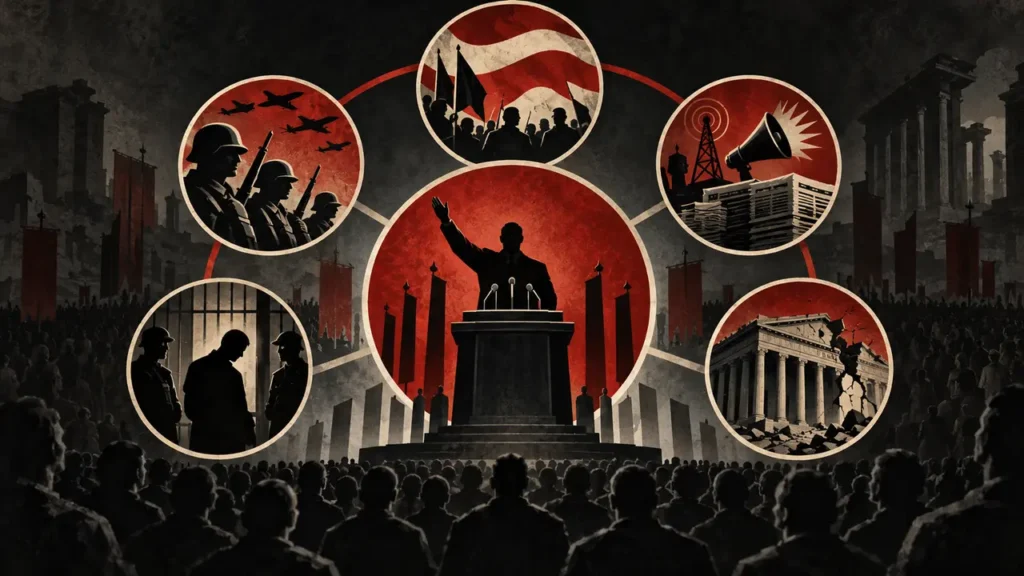

Throughout modern history, political movements have influenced societies, transformed governments, and shaped the direction of entire nations. Among these movements, fascism remains one of the most controversial and widely discussed political ideologies. The term fascisterne is associated with fascists and the historical development of fascist movements, particularly in European history. Understanding this subject requires looking beyond political labels and examining the beliefs, historical events, leaders, and social conditions that contributed to the rise of fascism.
Fascism became especially influential during the early twentieth century. It emerged during a period marked by economic uncertainty, political instability, nationalism, and widespread social dissatisfaction. Although fascist movements developed differently across countries, they generally promoted authoritarian leadership, extreme nationalism, centralized political power, and strict social control.
Today, studying fascisterne provides valuable historical lessons about democracy, political freedom, propaganda, and the importance of protecting individual rights.
What Does Fascisterne Mean?
The word fascisterne is a Danish term that translates roughly to “the fascists” in English. It refers to people who support or participate in fascist political movements. The term is connected to fascism, an authoritarian political ideology that became prominent in Europe during the twentieth century.
Fascism generally emphasizes national unity, strong centralized authority, obedience to political leadership, and the belief that individual interests should be subordinate to the state or nation. Fascist movements have historically opposed liberal democracy, political pluralism, and many forms of socialism and communism.
However, fascism is not simply another word for authoritarian government. It also involves a particular political vision built around national revival, aggressive nationalism, political mobilization, and the rejection of democratic limitations on state power.
Understanding the meaning of fascisterne therefore requires considering both the ideology itself and the historical circumstances in which fascist movements gained influence.
The Historical Origins of Fascism
fascisterne developed in Europe during the years surrounding the First World War. The conflict caused enormous destruction, economic disruption, political instability, and widespread disappointment. Millions of people experienced the consequences of war, while many countries struggled to rebuild their economies and political institutions.
Italy became the birthplace of the first major fascist movement. After the First World War, the country experienced unemployment, labor strikes, political conflict, and dissatisfaction with its government. Many Italians believed that their country had not received the international recognition or territorial rewards they expected after the war.
These conditions created opportunities for political movements promising national strength, order, and economic recovery.
In 1919, Benito Mussolini established the Fasci Italiani di Combattimento, a political movement that eventually developed into the National Fascist Party. Mussolini presented himself as a powerful leader capable of restoring national pride and overcoming political divisions.
In 1922, the March on Rome helped bring Mussolini to power. He gradually transformed Italy into a dictatorship, weakening democratic institutions and suppressing political opposition.
The Italian experience became an important reference point for other fascist movements throughout Europe.
Main Characteristics of Fascist Ideology
Fascism has appeared in different historical and national contexts, but several characteristics are commonly associated with the ideology.
1. Extreme Nationalism
Nationalism is one of the central elements of fascist political thinking. Fascist movements often present the nation as an extraordinary community that must remain united, powerful, and independent.
They frequently promote national identity through historical symbols, military traditions, cultural narratives, and political celebrations.
However, fascist nationalism often goes beyond ordinary patriotism. It can portray other nations, ethnic communities, or political groups as threats to national greatness.
2. Authoritarian Leadership
Fascist movements traditionally support strong centralized leadership. Their leaders are presented as individuals who understand the nation’s needs and possess the authority to make important decisions without significant political opposition.
This approach often weakens democratic institutions and reduces opportunities for citizens to challenge government decisions.
Historical fascist governments used political intimidation, censorship, and repression to maintain their authority.
3. Opposition to Political Pluralism
Democratic societies generally allow different political parties, opinions, organizations, and beliefs to compete peacefully.
Fascist movements reject this approach when they seek exclusive political control. They often portray political disagreement as disloyalty or a threat to national unity.
As a result, independent organizations and opposition parties may face restrictions, intimidation, or outright bans under fascist governments.
4. Propaganda and Political Control
Propaganda played an important role in the development of historical fascist movements.
Political leaders used newspapers, public speeches, posters, radio broadcasts, and organized demonstrations to influence public opinion.
These communication methods helped create powerful political images of national strength and leadership. They also allowed governments to spread misleading information, promote ideological narratives, and discredit opponents.
5. Militarism and Political Violence
Many fascist movements glorified military strength, discipline, sacrifice, and obedience.
They frequently presented military organization as a model for society. Violence was sometimes justified as a necessary method of protecting the nation or achieving political objectives.
Historical fascist organizations also used intimidation and physical attacks against political opponents.
Fascisterne and the Rise of Nazi Germany
One of the most significant chapters in the history of fascism concerns the rise of Adolf Hitler and the Nazi Party in Germany.
Germany faced severe economic and political difficulties following the First World War. The Treaty of Versailles, political instability, unemployment, and the Great Depression contributed to widespread dissatisfaction.
The Nazi Party exploited these conditions by promoting extreme nationalism, antisemitism, racial ideology, and authoritarian leadership.
Hitler became chancellor in 1933 and rapidly dismantled Germany’s democratic institutions. The Nazi government established a totalitarian dictatorship and used propaganda, secret police, imprisonment, and systematic violence to control the population.
Although Italian Fascism and German Nazism shared important characteristics, they were not identical. Nazi ideology placed an especially central role on racial hierarchy and antisemitism.
The Nazi regime was responsible for the Holocaust, during which six million Jewish people were murdered, alongside millions of other victims of persecution and mass violence.
The Second World War, which began in Europe in 1939 following Germany’s invasion of Poland, resulted in extraordinary destruction and loss of life.
These events demonstrate the catastrophic consequences of extremist authoritarian ideologies.
The Role of Propaganda in Fascist Movements
Propaganda was one of the most effective political tools used by historical fascist governments.
Rather than depending entirely on military force, fascist leaders attempted to influence how citizens understood national identity, political authority, and social problems.
Public events, national celebrations, political symbols, and carefully controlled media helped create an image of unity and strength.
Propaganda frequently simplified complicated issues into emotionally powerful messages. It could blame particular groups for economic difficulties, portray political opponents as enemies, or present a political leader as the only person capable of saving the country.
The development of radio and modern mass communication made these techniques especially influential during the twentieth century.
Modern researchers continue to examine these historical methods because propaganda remains an important subject in discussions about political communication and media literacy.
Fascisterne and the Impact on Society
The consequences of fascist rule extended far beyond government institutions. Fascist political systems affected education, employment, cultural expression, journalism, family life, and personal freedoms.
Education systems were sometimes reorganized to promote government ideology. Independent newspapers faced censorship, while artists and writers could experience restrictions if their work challenged political authority.
Political opponents, minority communities, and individuals considered undesirable by the regime faced discrimination, imprisonment, persecution, and violence.
These policies damaged social trust and weakened the institutions that protect individual rights.
The economic consequences also varied between countries. Fascist governments sometimes promoted major infrastructure projects, industrial development, and military production. However, economic activity operated under significant political control and was often directed toward nationalistic and military objectives.
The overall historical record shows that economic or infrastructure achievements cannot be separated from the repression, discrimination, and violence associated with fascist regimes.
The Decline of Fascism After World War II
The Second World War played a decisive role in the collapse of major European fascist governments.
In 1943, Mussolini was removed from power following Italy’s military failures and political crisis. Although he later headed a German-supported regime in northern Italy, he was captured and executed in 1945.
Germany’s Nazi government collapsed in May 1945 after the Allied victory in Europe. Hitler died in April 1945 as Soviet forces entered Berlin.
Following the war, international efforts focused on rebuilding European societies, establishing democratic institutions, and holding individuals responsible for wartime crimes.
The Nuremberg Trials prosecuted leading Nazi officials for crimes against peace, war crimes, and crimes against humanity.
These developments helped establish important principles of international criminal responsibility and reinforced the importance of protecting human rights.
How Fascist Ideas Are Discussed Today
Although the major historical fascist regimes were defeated during the Second World War, discussions about fascism continue in modern political and academic environments.
Researchers examine historical fascism to understand how democratic societies can become vulnerable to authoritarian movements.
Contemporary political debates sometimes use the term fascist to describe governments, political organizations, or public figures. However, historians emphasize the importance of using the term carefully rather than applying it to every authoritarian policy or controversial political position.
A meaningful analysis should consider specific characteristics, including extreme nationalism, political violence, authoritarian leadership, suppression of opposition, and hostility toward democratic institutions.
The word fascisterne also appears in historical discussions, political commentary, educational materials, and Danish-language publications.
Studying the term can help readers understand how political language changes across different cultures and historical periods.
The Importance of Understanding Fascisterne in Education
Learning about fascisterne is important because history provides valuable lessons about political responsibility and democratic stability.
Students who study fascism can better understand how economic crises, political polarization, propaganda, and institutional weaknesses contributed to authoritarian movements.
Historical education also helps explain why independent journalism, freedom of expression, fair elections, and legal protections are essential elements of democratic societies.
Another important lesson concerns the treatment of minority communities. Historical fascist regimes demonstrated how discrimination and dehumanizing political language could contribute to widespread persecution.
Understanding these events encourages critical thinking and helps people recognize the dangers of political extremism.
Rather than treating history as a collection of dates and names, education should examine the decisions, institutions, and social conditions that shaped important historical developments.
Fascism, Democracy, and Individual Freedom
One of the most important differences between fascist political systems and democratic societies concerns the position of individual freedom.
Democracy depends on public participation, constitutional protections, political competition, and the ability of citizens to criticize their leaders.
Fascist systems traditionally seek to concentrate political authority and subordinate individual interests to the goals of the state or national movement.
This difference affects nearly every part of public life.
In democratic societies, independent courts can review government actions, journalists can investigate political decisions, and opposition parties can challenge those in power.
Under historical fascist governments, these institutions were weakened or transformed into instruments of political control.
The comparison demonstrates why democratic institutions require continuous protection and public participation.
How to Recognize Historical Fascist Patterns
Understanding historical patterns can help readers evaluate political movements more carefully.
Some warning signs associated with historical fascist movements include:
- Promoting extreme nationalism and national superiority.
- Presenting one political leader as the unquestionable representative of the nation.
- Encouraging hostility toward political opponents.
- Attacking independent journalism and freedom of expression.
- Supporting political intimidation or violence.
- Weakening democratic institutions and legal protections.
- Using propaganda to spread fear and division.
- Describing minority communities as threats to national identity.
These characteristics should be evaluated within their historical and political context. A single characteristic does not automatically establish that a particular movement is fascist.
Careful analysis requires examining the movement’s overall ideology, political behavior, organizational structure, and attitude toward democratic institutions.
Conclusion
Fascisterne is a historically significant term connected to the people and movements associated with fascism. Its meaning becomes clearer when examined through the political developments of twentieth-century Europe, particularly the rise of Mussolini in Italy and Hitler in Germany.
Fascism developed during periods of political instability, economic hardship, and widespread social dissatisfaction. Its emphasis on extreme nationalism, authoritarian leadership, propaganda, and political control had devastating consequences for millions of people.
The defeat of fascist regimes during the Second World War marked an important turning point in modern history. Nevertheless, studying fascism remains essential for understanding political extremism, democratic vulnerability, and the importance of individual rights.
Ultimately, learning about fascisterne is not simply an exercise in remembering historical events. It is an opportunity to understand how societies change, how political movements gain influence, and why freedom, equality, accountability, and democratic institutions deserve protection.