
In today’s digital world, people use abbreviations and slang to communicate quickly. From text messages and Instagram comments to Snapchat conversations and TikTok posts, short expressions have become a normal part of everyday communication. However, not every abbreviation is easy to understand, especially when it has multiple meanings depending on the situation. One such abbreviation is YFM.
If you have recently seen YFM in a text message, social media comment, or online conversation, you might be wondering what it means. Understanding the context can help you interpret the message correctly and respond naturally.
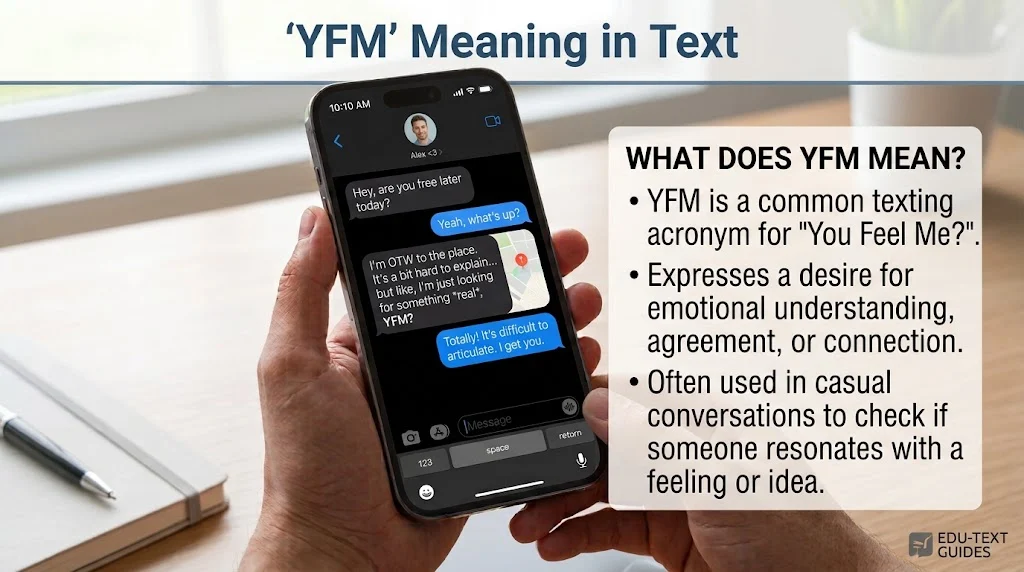
The YFM meaning in text is commonly understood as “You Feel Me?” This phrase is used to ask whether someone understands what you are saying, agrees with your point, or relates to your feelings or experience. It is an informal expression that often appears in casual conversations between friends.
However, YFM can have other meanings depending on the conversation, the people using it, and the platform where it appears. In this article, we will explore the meaning of YFM, how people use it, examples of conversations, and tips for understanding this popular texting abbreviation.
What Does YFM Mean in Text?
YFM usually stands for “You Feel Me?” in texting and online communication.
Although the phrase might sound unusual when interpreted literally, it is generally not about physical touch. Instead, it asks whether another person understands your thoughts, emotions, opinions, or experiences.
For example, imagine that someone has had a stressful day at school or work. They might send a message saying:
“I’ve been working all week without a break, yfm?”
In this example, the sender is asking whether the other person understands how tiring the situation feels. They want the listener to relate to their experience.
YFM can also be used when someone shares an opinion or explains a personal situation. It creates a conversational tone and encourages the other person to acknowledge the message.
Here are the main ideas associated with YFM:
- Understanding: Asking whether someone understands your point.
- Agreement: Checking whether another person agrees with what you are saying.
- Relatability: Asking whether someone can relate to your experience.
- Emotional connection: Looking for acknowledgment or empathy.
The exact meaning depends on the surrounding words. In most casual texting situations, however, “You Feel Me?” is a useful interpretation.
Why Do People Use YFM in Text Messages?
People use abbreviations because they make digital communication faster and more convenient. Instead of typing a complete phrase, someone can use three letters to communicate the same idea.
yfm meaning in text is particularly useful in informal conversations because it sounds relaxed and familiar. It can help a message feel more natural, especially when people are discussing personal experiences, opinions, relationships, or everyday problems.
There are several reasons why someone might use YFM.
1. To Check Whether Someone Understands
One of the most common reasons to use YFM is to check whether the other person understands your point.
For example:
“I tried explaining everything to him, but he still didn’t listen, yfm?”
The sender wants the recipient to understand their frustration. They are not necessarily asking for advice. They may simply want someone to acknowledge what happened.
2. To Ask for Agreement
YFM can also function as an informal way to ask whether someone agrees with an opinion.
For example:
“People should respect your time if they expect you to respect theirs, yfm?”
Here, the sender is sharing a belief and asking the recipient whether they agree.
3. To Build an Emotional Connection
When people discuss difficult experiences, they often want to know whether someone understands how they feel.
For instance:
“Sometimes you need a break from everything just to clear your mind, yfm?”
In this case, YFM encourages the other person to relate to the feeling of needing peace and personal space.
4. To Make Conversations Sound Casual
YFM fits naturally into informal conversations with friends, classmates, relatives, and people who are comfortable using internet slang.
Rather than sounding formal, it makes the conversation feel relaxed and conversational.
However, it is generally less appropriate in professional emails, formal reports, or serious business discussions unless the people involved already communicate informally.
YFM Meaning on Snapchat, Instagram, and TikTok
The meaning of an abbreviation can sometimes vary between social media platforms. YFM is no exception, although its common interpretation as “You Feel Me?” generally remains the same.
YFM Meaning on Snapchat
On Snapchat, people often use short abbreviations to keep conversations quick and informal. YFM may appear in a direct message, a snap caption, or a reply to a personal story.
For example:
“I’m tired of dealing with the same drama every day, yfm?”
The sender is asking whether the recipient understands the frustration being expressed.
If someone sends you YFM on Snapchat, read the entire message before deciding what they mean. The abbreviation usually invites understanding or agreement rather than asking a literal question about feelings.
YFM Meaning on Instagram
On Instagram, YFM may appear in comments, captions, direct messages, or conversations about personal opinions.
For example:
“Protecting your peace is more important than pleasing everyone, yfm.”
In this context, the phrase encourages readers to relate to the statement.
Someone might also use YFM while talking about friendships, relationships, personal growth, or everyday challenges.
YFM Meaning on TikTok
TikTok users frequently communicate through short comments, captions, and slang. YFM may be used when someone shares an experience that other people can relate to.
For example:
“When you finally realize that not everyone deserves access to your life, yfm.”
Here, YFM invites viewers to understand or agree with the message.
The abbreviation may also appear in comments responding to videos about relationships, school, work, or personal experiences.
Remember that platform culture does not guarantee a particular meaning. The surrounding conversation remains the most reliable clue.
Examples of YFM in Everyday Conversations
The easiest way to understand YFM is to see how people use it in realistic conversations. The following examples demonstrate how the abbreviation works in different situations.
Talking About a Difficult Day
Person A: “I’ve had three exams this week, and I’m completely exhausted.”
Person B: “I understand. That’s a lot to deal with.”
Person A: “Exactly, yfm?”
Here, YFM means “You Feel Me?” The sender wants confirmation that the other person understands the pressure they are experiencing.
Discussing Friendship
Person A: “A real friend supports you even when things aren’t going well.”
Person B: “That’s true.”
Person A: “Loyalty matters more than popularity, yfm?”
In this example, YFM asks whether the recipient agrees with the sender’s opinion about friendship.
Talking About Relationships
Person A: “I don’t want to keep explaining my feelings to someone who never listens.”
Person B: “You deserve someone who communicates properly.”
Person A: “Exactly, yfm.”
The sender uses YFM to emphasize their feelings and invite understanding.
Discussing Personal Goals
Person A: “I’m trying to focus on my goals instead of worrying about everyone’s opinions.”
Person B: “That’s a good mindset.”
Person A: “I just want to improve myself, yfm?”
Here, YFM communicates the desire to be understood by someone who shares or respects the same perspective.
Talking About Money
Person A: “Saving money is difficult when you have so many responsibilities.”
Person B: “Definitely. Everything costs so much these days.”
Person A: “You have to plan carefully, yfm?”
The phrase helps the sender connect their experience with the recipient’s understanding of financial responsibilities.
Sharing an Opinion Online
Person A: “Sometimes staying quiet is better than arguing with people who refuse to listen.”
Person B: “I agree.”
Person A: “Peace is more important, yfm.”
In this situation, YFM reinforces a shared viewpoint and makes the statement sound informal.
These examples demonstrate that YFM can express understanding, agreement, and emotional connection without changing its basic conversational purpose.
Other Possible Meanings of YFM
Although “You Feel Me?” is a common interpretation in texting, abbreviations do not always have one universal definition. YFM may stand for something else in a particular community, organization, or online discussion.
For example, an abbreviation might be used as the name of a radio station, a brand, a group, or a specialized organization. In those situations, the intended meaning may have little connection to texting slang.
When interpreting YFM, consider these factors:
- The conversation topic: Is someone discussing feelings, opinions, or everyday experiences?
- The platform: Does the abbreviation appear in a casual message or in an informational post?
- The surrounding words: Does the sentence sound natural if YFM means “You Feel Me?”
- The relationship between the people: Are they friends using familiar slang, or are they discussing something professional?
For instance, if a friend writes, “Life gets complicated sometimes, yfm?” the texting interpretation makes sense.
However, if YFM appears on a radio station’s promotional material, it could refer to the station’s name or branding.
The important lesson is not to assume that every occurrence of YFM has the same meaning. Context helps you distinguish texting slang from other uses of the abbreviation.
Is YFM Rude or Disrespectful?
Generally, YFM is not a rude or offensive abbreviation. It is usually a casual expression used to ask for understanding or agreement.
Nevertheless, the tone of a message can change how the phrase is received.
For example, consider this message:
“You keep making the same mistake, yfm?”
Depending on the relationship and conversation, the message might sound frustrated or critical.
Now consider this message:
“Sometimes you just need someone who understands you, yfm?”
This version sounds more thoughtful and emotionally expressive.
The abbreviation itself does not determine whether a message is friendly, serious, or confrontational. The wording, punctuation, and relationship between the sender and recipient all influence its tone.
If you are unsure whether someone is being sarcastic or serious, look at the rest of the conversation rather than relying on YFM alone.
How Should You Reply to YFM in a Text?
If someone sends you YFM, you can respond in several ways depending on whether you understand their point, agree with them, or need clarification.
When You Understand and Agree
If you understand the message and share the same opinion, you can respond naturally.
Examples include:
- “Yeah, I feel you.”
- “Exactly!”
- “I get what you mean.”
- “For real.”
- “That’s so true.”
These responses show that you understand the sender’s perspective.
When You Understand but Disagree
You can acknowledge someone’s point without agreeing with everything they say.
For example:
“I get what you’re saying, but I see it a little differently.”
This response keeps the conversation respectful while allowing you to express your own opinion.
When You Relate to Their Experience
If the sender is talking about a difficult situation, you might respond with empathy.
For example:
“Yeah, I’ve been through something similar.”
Or:
“I understand. That sounds really frustrating.”
These replies show that you recognize the person’s feelings.
When You Do Not Understand
There is nothing wrong with asking for clarification.
You could say:
- “What do you mean?”
- “Can you explain that a little more?”
- “I’m not sure I understand your point.”
It is better to ask a question than to pretend you understand something that is unclear.
YFM vs. Similar Texting Abbreviations
YFM is one of many expressions people use to communicate understanding, agreement, or relatability. Knowing similar abbreviations can help you understand informal messages more easily.
| Abbreviation | Meaning | Common use |
|---|---|---|
| YFM | You Feel Me? | Asking whether someone understands or relates |
| WYD | What You Doing? | Asking what someone is doing |
| FR | For Real | Showing agreement or emphasizing sincerity |
| IYKYK | If You Know, You Know | Referring to an experience understood by certain people |
| IMO | In My Opinion | Introducing a personal viewpoint |
| TBH | To Be Honest | Expressing an honest thought or opinion |
| NGL | Not Gonna Lie | Introducing a candid statement |
| IKR | I Know, Right? | Expressing agreement or shared understanding |
Although some of these abbreviations serve similar conversational purposes, they are not interchangeable in every situation.
For example, FR usually emphasizes agreement or sincerity, while YFM directly asks whether someone understands or relates to the message. Similarly, IYKYK suggests that a particular experience or reference will be understood by people familiar with it.
Choosing the right abbreviation depends on what you want to communicate.
Is YFM Appropriate for Formal Communication?
YFM is best suited to informal communication. It can work well in conversations with friends, relatives, or people who regularly use texting slang.
However, it is usually better to avoid YFM in formal or professional settings.
For example, if you are writing an email to a manager, you could replace YFM with a clearer expression such as:
- “Do you understand what I mean?”
- “Does that make sense?”
- “Would you agree with this point?”
- “I hope this explains my perspective.”
These alternatives sound more professional and communicate the intended message directly.
The same principle applies to academic writing, business proposals, customer service messages, and formal presentations. Standard language helps reduce confusion when the audience may not be familiar with internet slang.
YFM is not inherently inappropriate, but its informal tone makes it less suitable for situations where clarity and professionalism are important.
Why Understanding Texting Slang Matters
Digital communication continues to evolve as people develop new abbreviations, expressions, and conversational habits. Understanding common slang can make online conversations easier to follow.
YFM is a good example because its meaning depends on both language and context. Someone unfamiliar with the expression might interpret it literally, while a person who regularly uses texting slang will usually recognize the intended question.
Learning these abbreviations can help you:
- Understand messages more quickly.
- Respond naturally in casual conversations.
- Recognize when someone is seeking agreement or emotional support.
- Avoid misunderstandings caused by unfamiliar expressions.
- Communicate more effectively on social media.
However, you do not need to use every abbreviation you encounter. Clear communication is more important than trying to sound trendy. If a complete phrase expresses your thoughts better, there is nothing wrong with writing it out.
Frequently Asked Questions About YFM Meaning in Text
1. What does YFM stand for in texting?
yfm meaning in text commonly stands for “You Feel Me?” It is an informal expression used to ask whether someone understands your point, agrees with your opinion, or relates to your experience.
2. What does YFM mean from a girl?
If a girl sends you YFM, she may be asking whether you understand what she is saying or relate to how she feels. The phrase does not automatically indicate romantic interest. Its meaning depends on the conversation and your relationship.
3. What does YFM mean from a guy?
When a guy uses YFM, he is generally checking whether you understand his thoughts or agree with his point. He might use it while discussing friendships, relationships, personal experiences, or everyday situations.
4. Does YFM mean “You Feel Me”?
Yes. “You Feel Me?” is a common meaning of YFM in casual text messages and online conversations.
5. Is YFM the same as FR?
No. YFM asks whether someone understands or relates to a statement, while FR means “For Real” and is often used to express agreement, seriousness, or emphasis. The expressions can appear in similar conversations, but their meanings are different.
6. Can YFM be used in a romantic conversation?
Yes. Someone might use YFM when discussing feelings, expectations, communication, or relationship problems. However, the abbreviation alone does not reveal whether the person has romantic feelings for you.
7. What is the best response to YFM?
If you understand the message, you can reply with “Yeah, I feel you,” “I get what you mean,” or “Exactly.” If you are confused, simply ask the sender to explain their point.
8. Is YFM still used in online conversations?
YFM may appear in informal messages and social media discussions, but its popularity varies by community and platform. Not everyone uses the same abbreviations, so it is helpful to understand the context rather than assume every person knows the expression.
Conclusion
Understanding the yfm meaning in text is simple once you recognize how people use the expression in everyday conversations. YFM commonly stands for “You Feel Me?” and is used to ask whether someone understands your thoughts, agrees with your opinion, or relates to your experiences.
You may encounter it on Snapchat, Instagram, TikTok, or in ordinary text messages. It often appears when people discuss friendships, relationships, personal challenges, or opinions they want others to understand.
Although YFM is generally informal and friendly, its tone depends on the surrounding message. It can express agreement, encourage empathy, or emphasize a point. In other contexts, the abbreviation may have a completely different meaning, making context especially important.
The next time someone sends you YFM, you will have a better idea of what they mean and how to respond. Whether you reply with “I feel you,” “I understand,” or a simple explanation of your own perspective, the goal is the same: to keep the conversation clear, natural, and meaningful.


